L-Systems
L-Systems
More about L-System: https://en.wikipedia.org/wiki/L-system
The main idea is that we have a sequence of variables and rules that we apply one by one and transform these variables to another ones. Like kid's game:
home -> mome
mome -> meme
...
The implementation includes parameters of variables and dynamic parameters which idea is to create new parameters based on the parameters of matched variables (like \1 references in regexps).
Example of generated picture:
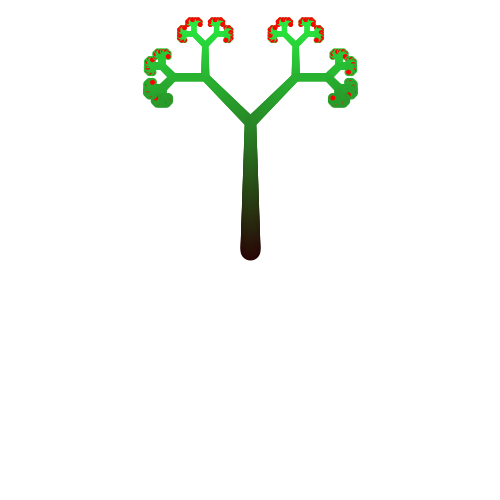
So, any "figures" are drawn by a set of rules. Most of such "systems" (sets) are "returnable", ie, it draws something then returns back to initial point (the root of the tree in this case), then the next leaf, etc. So, if we want to code a color and a width with variables' parameters then they should take into account that "the next" (i+1) can mean "more close to the root". So, rules in the tree in this implementation don't use parameters for color (more black on the root) and for the width/thickness - it uses a special method draw_attrs() (context manager actually) that is called before to draw and after (to set/reset attributes).
The implementation depends on svg_turtle (must be installed with pip). The code:
# The idea is to iteratively match variables and to replace them with another one,
# step by step. Like A -> AB (where A,B are variables)... Finally it's unfolded
# into some long sequence of variables that can be treated in some way (to draw
# picture, to play music, etc).
# More: https://en.wikipedia.org/wiki/L-system
#
# Parameters of variables are supported including dynamic ones (based on original,
# matched variables, as references in regexp). But for color, width set they are
# not used - context manager `draw_attrs()` is used instead of, because draw of
# PythTree is as to-leaf/back-to-root, to-leaf/back-to-root... and in this case
# colors would be black/white, black/white... not black/lighter/more-ligher/white.
# So, the context manager calculates relative Y-coord (how far it's from the root)
# and sets color/width.

# TODO draw from the bottom of the screen
# TODO support big number of iterations
# TODO set thickness and color using `pars`

import random
import svg_turtle
from contextlib import contextmanager


################################## L-System ####################################

class DynPars:
  """Dynamic parameters: they can get parameters of matched variables and to
  transform them into parameters of new coming (tail) variables
  """
  def __init__(self, new_pars=None):
    self.new_pars = new_pars or (lambda a: a)

  def tail_pars(self, tail_vars, matched_vars_pars):
    tail_vars_pars = list(self.new_pars(matched_vars_pars))
    if len(tail_vars_pars) == 1:                       # XXX not sure
      tail_vars_pars = tail_vars_pars * len(tail_vars) # XXX not sure
    for i in range(len(tail_vars)):
      if i >= len(tail_vars_pars):
        break
      tail_vars[i].pars = tail_vars_pars[i]
    # print(matched_vars_pars, '=>', tail_vars)
    return tail_vars


class Var:
  def __init__(self, name, pars=None):
    self.name = name
    self.pars = pars or []

  def __eq__(self, oth):
    if self.name != oth.name: return False
    for i in range(min(len(self.pars), len(oth.pars))):
      if self.pars[i] != oth.pars[i]: return False
    return True

  @classmethod
  def make(cls, s, pars=None):
    """Short factory creating a list of Var-s: 1 letter in `s` is a name of 1 Var"""
    return [cls(ch, pars or []) for ch in s]

  def __repr__(self):
    pars = str(tuple(self.pars)) if self.pars else ''
    return f'"{self.name}"{pars}'


class Rule:
  """Rule transforming head Var-s to tail Var-s"""
  def __init__(self, head, tail):
    self.head = head
    self.tail = tail

  @classmethod
  def make(cls, heads, tails, heads_pars=None, tails_pars=None):
    """Short factory: heads, tails are strings where 1 letter is one Var name"""
    return cls(Var.make(heads, heads_pars), Var.make(tails, tails_pars))

  def match(self, vars):
    head_len = len(self.head)
    vars_len = len(vars)
    if vars_len < head_len:
      return {'matched': False, 'shift': 0}
    elif head_len == 0:
      return {'matched': True, 'shift': 1}
    elif all(self.head[i] == vars[i] for i in range(head_len)):
      return {'matched': True, 'shift': head_len}
    else:
      return {'matched': False, 'shift': 0}

  def __repr__(self):
    return f'{self.head}->{self.tail}'


class Prefer:
  """How to select a rule when multiple rules matched"""
  FIRST = 1
  LAST = 2
  RANDOM = 3


class Lsys:
  def __init__(self, rules, axiom, dyn_pars=None):
    self.rules = rules
    self.axiom = axiom
    self.dyn_pars = dyn_pars

  def refer_pars(self, tail_vars, matched_vars_pars):
    if self.dyn_pars:
      return self.dyn_pars.tail_pars(tail_vars, matched_vars_pars)
    else:
      return tail_vars

  def apply_one_rule(self, vars, prefer=Prefer.LAST):
    """Applies one of known rules to input `vars`"""
    matched_rules = []
    for rule in self.rules:
      match_res = rule.match(vars)
      if match_res['matched']:
        matched_rules.append((rule, match_res))

    if len(matched_rules) > 1:
      if prefer == Prefer.LAST:
        matched = matched_rules[-1]
      elif prefer == Prefer.FIRST:
        matched = matched_rules[0]
      elif prefer == Prefer.RANDOM:
        matched = matched_rules[random.randint(0, len(matched_rules) - 1)]
    elif len(matched_rules) == 1:
      matched = matched_rules[0]
    elif len(matched_rules) == 0:
      matched = None

    if matched is None:
      matched_pars = [v.pars for v in vars[:1]]
      #print('1', matched_pars, len(vars[:1]))
      ret = {'applied': vars[0:1], 'rest': vars[1:]}
    else:
      matched_rule, match_res = matched
      new_vars = matched_rule.tail[:]
      matched_pars = [v.pars for v in vars[:match_res['shift']]]
      ret = {'applied': new_vars, 'rest': vars[match_res['shift']:]}
    if matched_pars:
      self.refer_pars(ret['applied'], matched_pars)
    return ret

  def apply_rules(self, vars, prefer=Prefer.LAST):
    """Performs 1 step of L-System: applies all rules on `vars` (input string)
    until the end of input string
    """
    result = []
    rest = vars[:]
    while rest:
      apply_res = self.apply_one_rule(rest, prefer)
      result += apply_res['applied']
      rest = apply_res['rest']
    return result

  def iapply(self, max_steps, prefer=Prefer.LAST):
    """Generates all transformations results"""
    vars = self.axiom[:]
    yield vars
    for step in range(max_steps):
      new_vars = self.apply_rules(vars, prefer)
      if new_vars == vars:
        break
      else:
        vars = new_vars
        yield new_vars
    return vars

  def apply(self, max_steps, prefer=Prefer.LAST):
    """Returns the last transformation result"""
    for r in self.iapply(max_steps, prefer):
      continue
    return r


#################################### Render ####################################
class IRender:
  """Render interface"""
  def __init__(self, lsys):
    self.lsys = lsys
    self.max_steps = 0

  def do_render(self, step, new_vars):
    return NotImplementedError

  def do_syntax_check(self, vars):
    """Raise exception on error in `vars`"""
    pass

  def render(self, max_steps):
    self.max_steps = max_steps
    for step, new_vars in enumerate(self.lsys.iapply(max_steps)):
      self.do_syntax_check(new_vars)
      self.do_render(step, new_vars)


class PythTree(IRender):
  """Pythagorean tree renderer using turtle interface"""
  ALPHABET = '[01]'
  def __init__(self, lsys, turtle, *, only_last_step=True, styles=None):
    super().__init__(lsys)
    self.turtle = turtle
    self.stack = []
    self.only_last_step = only_last_step
    self.styles = styles or {}
    self.y0 = None  # start of drawing, 1st point

  def do_syntax_check(self, new_vars):
    for var in new_vars:
      if var.name not in self.ALPHABET:
        raise RuntimeError(f'Unsupported variable {var.name}')

  def do_render(self, step, new_vars):
    draw = (not self.only_last_step) or (step == self.max_steps)
    if draw:
      self.turtle.pencolor(self.styles.get('branch_color', 'black'))
      self.turtle.screen.colormode(255)
      self.turtle.pendown()
      for var in new_vars:
        with self.draw_attrs():
          self.interp_var(var)
      self.turtle.penup()

  @contextmanager
  def draw_attrs(self):
    y = self.turtle.ycor()
    if self.y0 is None:
      self.y0 = y
      self.turtle.screen.colormode(255)
    c0 = self.turtle.pencolor()
    w0 = self.turtle.width()
    color_step = abs(y - self.y0)
    c1 = [40, 5 + color_step, 5 + color_step/4]  # current color
    w1 = 20 - abs(y - self.y0)/15                # current width
    self.turtle.pencolor(c1)
    self.turtle.width(w1)
    yield None
    self.turtle.pencolor(c0)
    self.turtle.width(w0)

  def interp_var(self, var):
    if var.name == '0':
      self.turtle.forward(2)
      c = self.turtle.pencolor()
      self.turtle.pencolor(self.styles.get('berry_color', 'red'))
      self.turtle.dot(5)
      self.turtle.pencolor(c)
    elif var.name == '1':
      self.turtle.forward(2)
    elif var.name == '[':
      pos, angle = self.turtle.pos(), self.turtle.heading()
      self.stack.append((pos, angle))
      self.turtle.penup()
      self.turtle.left(45)
      self.turtle.pendown()
    elif var.name == ']':
      pos, angle = self.stack.pop()
      self.turtle.penup()
      self.turtle.setpos(pos)
      self.turtle.setheading(angle)
      self.turtle.right(45)
      self.turtle.pendown()


#############################
# Test 1
##rules = [Rule.make('A','AB'), Rule.make('B','A')]
##ls = Lsys(rules, Var.make('A'))
###r = ls.apply_rules(Var.make('ABAAB'))
##r = ls.apply(7)  # WORKS
##print(r)

# Test 2
##rules = [Rule.make('1','11'), Rule.make('0','1[0]0')]
##ls = Lsys(rules, Var.make('0'))
###r = ls.apply_rules(Var.make('1[0]0'))
##r = ls.apply(3)  # WORKS
##print(r)

# Just example how to change parameters dynamically
# def new_pars(old_pars):
#   for pars in old_pars:
#     if len(pars) == 4:
#       r, g, b, thickness = pars
#       res = [min(255, r+1), min(255, g+1), min(255, b+1), thickness+0.1]
#       yield res

rules = [Rule.make('1','11'), Rule.make('0','1[0]0')]
# Example of usage of dynamic parameters
# ls = Lsys(rules, Var.make('0', [2,2,2,0.5])), DynPars(new_pars))
ls = Lsys(rules, Var.make('0'))
t = svg_turtle.SvgTurtle(1000, 1000)
def go(t, heading=90, pos=(0,0), styles=None):
  t.penup()
  t.setheading(heading)
  t.setpos(*pos)
  t.pendown()
  pt = PythTree(ls, t, styles=styles)
  pt.render(7)
go(t)
t.save_as('ls.svg')