Low-pass filter
Low-pass filter
One of the low-pass filters software algorithm is described on http://en.wikipedia.org/wiki/Low-passfilter. Here is the example of Python implementation:
# Low-pass filter
import random

RC = 0.05 # time constant (inertion)
DT = 0.02 # sampling time

A = DT/( RC + DT)
#A = 0.45
xk_1 = 0
print "Measured;Filtered"
for i in xrange(0, 200):
    xm = random.randint(0, 2)
    # Both are equals:
    #xk = A*xm + (1-A)*xk_1
    xk = xk_1 + A * (xm - xk_1)
    print "%d;%f" % (xm, xk)
    xk_1 = xk
With RC (tau) we can control inertia of the filter.
Here is the example how looks low-pass filter with tilt angles getting data from HMC6343 (F-16 seems to be more stable):
If you try to filtering tilt angles then you can see funny effect: turning of 3D model! It's happens due to error in sensor data which filter try to smooth, see image:
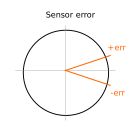
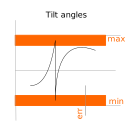
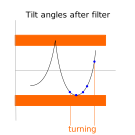
Near the scale edges error seems to be small, but angles may be, for ex., 10°, 350°, and filter will smooth their to 10°, 20°, 30°… 340°. And you can see rotation of the model on the screen. One of the approach to avoid this problem is to normalize angles. For example, 10°, 350° may be converted to 10°, -10°. After such normalization angles great then 360° should be normalized to canonical range. Algorithm is easy:
absdiff = abs(v1 - v0)
if absdiff > 180.:
  d = 360. - absdiff
  if v0 > v1:
    v1 = v0 + d
  else:
    v1 = v0 - d
And after filtering to avoid values great then 360° we can use something like this:
if abs(v) >= 360.:
  v = v % 360.